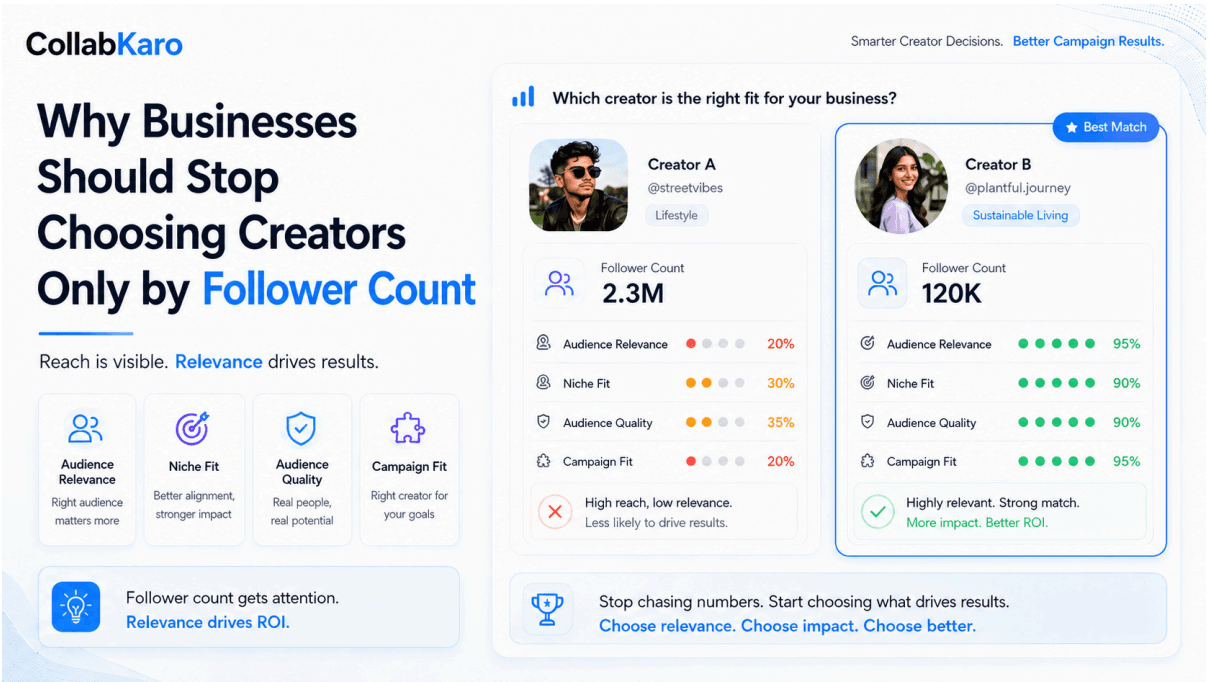
The biggest mistake in influencer marketing is assuming that more followers means better results. For a long time, businesses have looked at influencer marketing in a very simple way:
"Who has the most followers?" And honestly, it makes sense at first. If someone has 1 million followers, they look more powerful than someone with 50,000 followers.
But after looking deeper into how creator collaborations actually work, we realized one thing very clearly:
Follower count is not the same as campaign fit.
A creator can have a huge audience and still not be the right person for your business. And another creator can have a smaller audience but still bring better attention, better trust, and better results. That is exactly why businesses need to stop choosing creators only by follower count.
Reach is important. But relevance is more important.
Let's take a simple example. Imagine a yoga or fitness business wants to promote its product. The business may think of collaborating with a celebrity or a large influencer who has millions of followers.
On paper, this looks like the best choice. But here's the problem. That audience may not be following the creator for fitness.
They may be following them because of entertainment, lifestyle, movies, fashion, popularity, or personal branding. So even if the creator has 30 million followers, only a small percentage of that audience may actually care about yoga, fitness, wellness, or health. Now compare that with a niche fitness creator.
Maybe they have 100K, 500K, or 3 million followers. But their audience follows them specifically for workouts, health tips, gym content, yoga routines, transformation journeys, diet advice, and fitness education. For a fitness business, that smaller creator may be much more valuable.
Because the audience is not just large. The audience is relevant. And in marketing, relevance often beats reach.
A big audience does not always mean a buying audience.
This is where many businesses go wrong. They see numbers and assume impact. But a follower is not always a potential customer.
A person may follow a creator because they like their lifestyle, humor, personality, or fame. That does not mean they will buy every product that creator promotes. For a campaign to work, the creator's audience should match the business goal. A business should ask:
- Does this creator's audience match my target customer?
- Does their content naturally fit my product?
- Do their followers trust their recommendations?
- Does this creator have influence in my category?
- Will this collaboration feel authentic or forced?
These questions matter more than just asking:
"How many followers do they have?"
The right creator is not always the biggest creator.
The right creator is the one whose audience, content, and trust match your business. For example:
A skincare business may get better results from a small beauty creator who consistently talks about skincare routines than from a large lifestyle creator who rarely talks about skincare. A local café may get better footfall from a city-based food creator than from a national influencer with a mixed audience. A fitness app may get better conversions from a focused gym creator than from a celebrity with a massive but scattered audience.
This is why creator selection should not be based only on popularity. It should be based on fit.
Growing creators are often underrated.
One of the biggest reasons we started thinking deeply about CollabKaro is because many growing creators are genuinely skilled, but they do not get enough visibility. They create good content. They understand their niche.
They have an engaged audience. They know how to communicate with their community. But because they do not have massive follower numbers, businesses often ignore them.
That is a missed opportunity. Many growing creators have stronger relationships with their audience because their community still feels personal and real. Their followers actually pay attention.
Their recommendations feel more authentic. Their content often feels less like an advertisement and more like a genuine suggestion. For businesses, this can be extremely powerful.
Businesses do not need more creator options. They need better creator recommendations.
The problem today is not that creators are hard to find. The problem is that the right creators are hard to identify. If a business posts "DM for collaboration" on Instagram, it may get hundreds of messages.
But then what? The business still has to manually check every profile, every reel, every niche, every engagement rate, every audience type, and every pricing expectation. This process is messy, slow, and often confusing.
And because there is no structured system, businesses usually fall back on the easiest visible metric:
follower count. But follower count is only one signal. It should not be the full decision.
A better system should look at:
- niche relevance
- content quality
- audience type
- engagement quality
- location
- campaign goal
- budget fit
- expected output
- past reliability
- business category fit
That is the direction influencer marketing needs to move toward.
A creator with fewer followers can still be a better business decision.
This is something every business should understand. A smaller creator can be better if:
- their audience is highly specific
- their engagement is strong
- their content is aligned with your business
- their followers trust them
- their pricing fits your budget
- their content style matches your campaign
- their audience is more likely to care about your product
A large creator can give reach. But the right creator gives relevance. And relevance is what creates better outcomes.
So what should businesses do instead?
Before selecting a creator, businesses should ask these questions:
1. Is this creator's audience relevant to my business?
If you sell fitness products, you need people who care about fitness. If you sell skincare, you need people interested in beauty, skincare, self-care, or wellness. If you sell food, you need people who follow food, lifestyle, or local discovery content.
Audience relevance comes first.
2. Does the creator's content naturally fit my product?
A collaboration should not look forced. If the creator has never spoken about your category, the audience may not take the promotion seriously. The best collaborations feel natural.
3. Is the engagement real?
A creator with fewer followers but real comments, saves, shares, and community trust can be more valuable than a creator with high followers and low interaction. Engagement quality matters.
4. Is the creator reliable?
Businesses also need to know:
- Will the creator deliver on time?
- Will they follow the brief?
- Will they communicate properly?
- Will they complete the deliverables?
A campaign is not just about posting content. It is also about execution.
5. Does the creator fit the campaign budget?
Sometimes the biggest creator is not the smartest financial decision. Businesses should look for value-for-money, not just popularity.
This is why CollabKaro is being built.
At CollabKaro, we believe businesses should not waste time choosing creators only by follower count. And creators should not be ignored just because they are still growing. Our goal is to help businesses discover creators and creative talent based on:
- relevance
- content quality
- audience fit
- niche strength
- campaign goals
- budget compatibility
Not just followers. Because influencer marketing should not be a guessing game. A business should be able to understand:
"Who is actually right for my campaign?" And a growing creator should be able to get discovered because of their skill, niche, and quality — not only because of their numbers.
Final thought
Follower count can show reach. But it cannot show trust. It cannot show audience intent.
It cannot show campaign fit. It cannot show whether a creator is actually right for a business. So the next time a business chooses a creator, the question should not be:
"Who has the most followers?" The better question is:
"Who has the most relevant audience for what we are trying to build?" That is where better creator marketing starts. And that is the future CollabKaro is building for.