Most businesses don't fail at creator marketing because the idea is bad. They fail because the budget is not planned properly. A lot of businesses today want to work with creators. They know influencer marketing is powerful.
They know creators can build trust. They know short-form content can bring attention. They know people listen more to creators than traditional ads.
But when it comes to actually planning a creator marketing budget, things become confusing. The first question usually is:
"How much should we spend?" But the better question is:
"How should we spend it?" Because spending ₹1 lakh randomly and spending ₹1 lakh with a proper plan are two completely different things. One can feel like a waste.
The other can become a growth experiment. That is why businesses need to stop treating creator marketing as just "paying influencers for posts." Creator marketing is not only about hiring influencers.
It is about planning the right mix of creators, content, deliverables, editing, design, execution, and tracking.
Your marketing budget should start with your goal
Before deciding the budget, a business needs to be clear about the goal. Because different goals need different spending plans. For example:
If your goal is awareness, you may need creators who can bring reach and visibility. If your goal is conversions, you may need niche creators with a highly relevant audience. If your goal is content creation, you may need UGC creators, video editors, and designers.
If your goal is social media growth, you may need consistency, content planning, editing, and a social media manager. If your goal is a product launch, you may need a mix of influencers, UGC, design, campaign planning, and tracking. So the first step is not choosing a creator.
The first step is asking:
"What exactly are we trying to achieve with this budget?" Without that clarity, businesses usually either overspend in the wrong place or expect too much from too little budget.
Don't spend the full budget only on influencers
This is one of the most common mistakes. A business may say:
"We have ₹1 lakh for marketing. Let's spend all of it on influencers." But then they forget the other parts needed to make the campaign work. Who will edit the content?
Who will design the creatives? Who will manage posting timelines? Who will coordinate with creators?
Who will track the campaign? Who will repurpose the content? Who will make sure the campaign has a proper message?
If the full budget goes only into influencer payments, the campaign may still feel incomplete. A good creator marketing budget should usually include different parts:
- creator collaborations
- UGC content
- video editing
- graphic design
- social media management
- campaign coordination
- tracking and reporting
Because marketing is not just visibility. Marketing is execution.
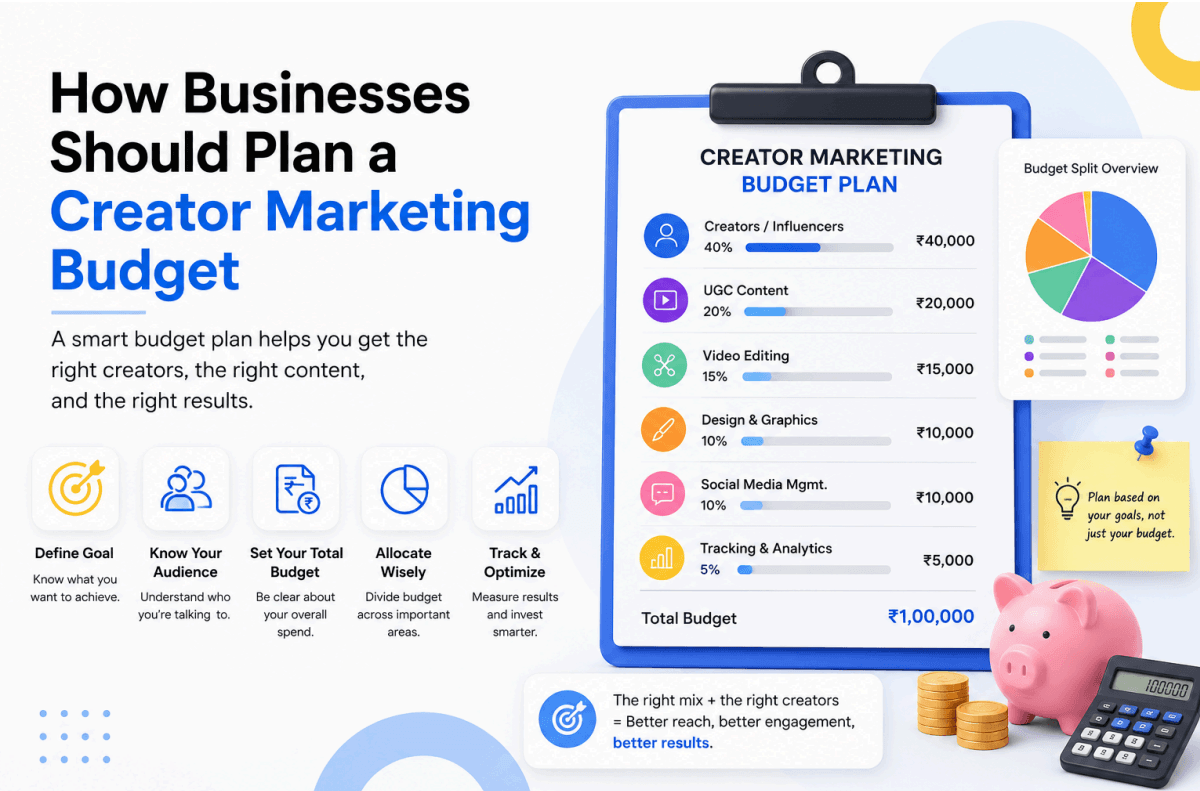
Example: How a business can plan a ₹1 lakh creator marketing budget
Let's say a yoga or fitness business has ₹1,00,000 to spend. Instead of randomly choosing 2 or 3 influencers, the budget can be planned more strategically. A possible split could be:
₹40,000 — Niche creators or influencers
Work with creators whose audience actually cares about yoga, fitness, wellness, or health.
₹20,000 — UGC creators or content production
Create authentic product videos, testimonials, or usage-based content.
₹15,000 — Video editing
Turn raw content into clean reels, ads, shorts, and reusable content.
₹15,000 — Graphic design and social creatives
Create posters, story creatives, campaign banners, and social media visuals.
₹10,000 — Campaign tracking and optimization
Track what worked, which creator performed better, and what should be improved next. This is just one example. The exact split will change depending on the business, goal, category, audience, and timeline.
But the important point is this:
A business should not just ask "which influencer can I afford?" It should ask "what marketing system can I build with this budget?"
A smaller budget can still work if expectations are realistic
Not every business starts with ₹1 lakh. Some may start with ₹10,000. Some may start with ₹25,000.
Some may start with ₹50,000. That is completely fine. But the expectations should match the budget.
For example, if a business says:
"I want 10 influencers, 50 reels, 1 million views, full social media handling, and guaranteed sales in ₹10,000" That is not a marketing plan. That is an unrealistic expectation.
With ₹10,000, the better plan may be:
- work with 1 or 2 small niche creators
- get 2 to 4 pieces of content
- test messaging
- understand audience response
- collect learnings for the next campaign
With ₹25,000, a business may be able to test:
- 3 to 5 micro creators
- a small UGC content batch
- a few edited reels
- basic campaign tracking
With ₹50,000, the campaign can become more structured:
- multiple niche creators
- edited content
- social media creatives
- a simple reporting layer
The budget does not need to be huge. But the plan needs to be honest.
Businesses should think in terms of experiments, not one-time magic
Creator marketing is not always about one big campaign. Especially for growing businesses, it should be treated like a series of experiments. The first campaign should answer:
- Which type of creator works best?
- Which message connects with the audience?
- Which content format performs better?
- Which audience segment responds more?
- What budget range gives better output?
- What should be improved next time?
When businesses think like this, even a small campaign becomes valuable. Because the goal is not just immediate reach. The goal is learning what works.
That learning becomes the foundation for bigger campaigns.
Choose creators based on relevance, not just price
Budget planning does not mean choosing the cheapest creator. And it also does not mean choosing the biggest creator. The right creator is the one who fits the campaign.
A creator should be evaluated based on:
- niche relevance
- content quality
- audience fit
- engagement quality
- location
- storytelling ability
- past work
- professionalism
- budget compatibility
- campaign goal
Sometimes a smaller creator with a strong niche audience can be more valuable than a large creator with a mixed audience. A business should not only ask:
"How much does this creator charge?" It should ask:
"Is this creator actually right for our business goal?" That difference matters.
Budget should also include content usage
Many businesses forget this part. When a creator makes content, the business may want to use it later for:
- Instagram posts
- ads
- website content
- product pages
- testimonials
- reels
- stories
- performance marketing
But content usage should be discussed clearly. Is the business only paying for one post on the creator's profile? Or can the business reuse the content?
Can it run ads using the content? Can it edit and repurpose the video? Can it use the creator's face in future creatives?
These things affect pricing. So while planning a creator marketing budget, businesses should also think about content rights and usage. Because sometimes the content itself is more valuable than the post.
Don't ignore execution cost
Creator marketing looks simple from the outside. But execution takes effort. Someone has to:
- shortlist creators
- discuss pricing
- explain the campaign brief
- finalize deliverables
- review content
- give approvals
- track deadlines
- handle payments
- collect insights
- measure results
If a business does this manually through DMs and WhatsApp, it becomes messy very quickly. That is why execution should also be considered part of the budget. Because a campaign does not succeed only because the creator is good.
It succeeds when the process is clear.
A good creator marketing budget has 5 layers
A strong budget should usually be divided into these five layers:
1. Creator cost
Payment or barter value for influencers, UGC creators, or creative talent.
2. Content production
Shooting, editing, design, copy, and creative assets.
3. Campaign management
Coordination, communication, approvals, timelines, and deliverables.
4. Distribution
Organic posting, creator posting, paid ads, boosting, or repurposing content.
5. Tracking and learning
Understanding reach, engagement, leads, conversions, and creator performance. Most businesses only plan the first layer. That is why many campaigns feel incomplete.
This is where CollabKaro comes in
At CollabKaro, we believe businesses should not have to guess how to spend their marketing budget. A business should be able to enter:
- budget
- category
- campaign goal
- target audience
- timeline
- expected outcome
- content requirement
And the platform should help them understand:
- how to divide the budget
- which creators or professionals they need
- what deliverables are realistic
- which creators fit the campaign
- when the budget is too low for the expectation
- how to manage execution properly
Initially, CollabKaro is helping businesses discover the right creators. But the bigger vision is much larger. We want CollabKaro to become an AI-powered marketing operating system where businesses can plan, hire, execute, and track marketing from one place.
Because businesses do not just need influencers. They need clarity. They need the right people.
They need execution. They need a system.
Final thought
A creator marketing budget should not be treated like a random expense. It should be treated like a structured growth plan. The question is not:
"How many influencers can we afford?" The better question is:
"What is the smartest way to use this budget to reach the right audience, create the right content, and learn what works?" That is where better marketing starts. And that is the future CollabKaro is building for.