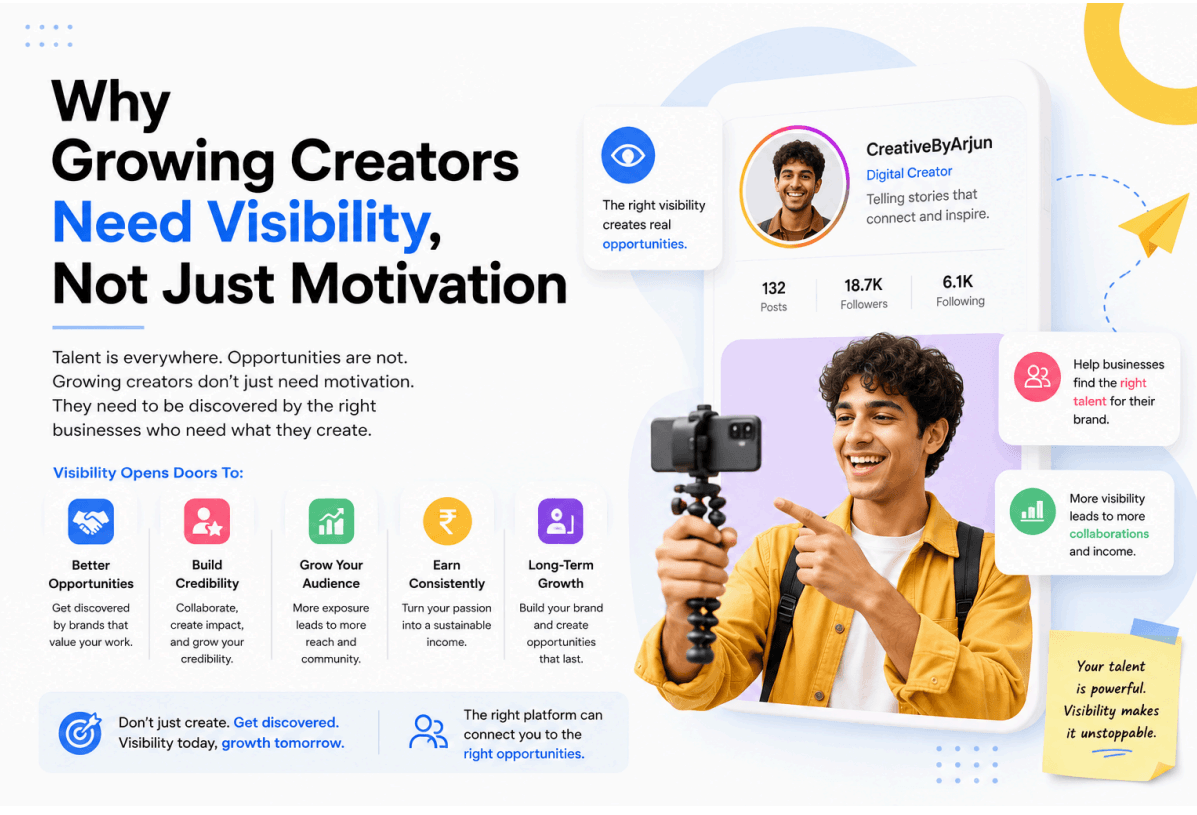
Most growing creators don't lack talent. They lack visibility in front of the right businesses. Every day, thousands of creators are posting content. Some are making reels.
Some are creating UGC videos. Some are editing videos. Some are designing creatives.
Some are building niche audiences around fitness, fashion, food, travel, tech, education, beauty, finance, and lifestyle. And many of them are genuinely good. Their content is clean.
Their ideas are strong. Their audience is real. Their niche is clear.
Their engagement is honest. But still, they struggle to get opportunities. Not because they are not talented.
But because the right businesses are not able to discover them. That is the real problem.
Motivation is not enough when opportunity is missing.
Growing creators are constantly told:
"Keep creating." "Stay consistent." "Don't give up."
"Your time will come." And yes, consistency matters. But motivation alone does not pay creators.
Motivation does not bring them business collaborations. Motivation does not put their profile in front of the right business. Motivation does not solve the discovery gap.
A creator can stay consistent for months and still not get noticed by businesses if there is no proper system that helps them become discoverable. That is why creators don't just need motivation. They need visibility.
The current creator discovery system is unfair to growing creators.
Right now, many businesses choose creators in a very simple way. They look at:
"Who has more followers?" And because of that, growing creators often get ignored. Even if they have:
- better niche relevance
- stronger content quality
- more authentic audience connection
- higher engagement
- better storytelling
- better local influence
- better trust within their community
They still lose opportunities because their follower count is smaller. This creates a very unfair situation. A creator with 10K highly relevant followers may be more useful for a business than a creator with 1M mixed followers.
But because businesses don't always have a structured way to compare creators, they often choose based on the easiest visible number:
followers. And that is where good growing creators get missed.
Growing creators are often closer to their audience.
One major advantage of growing creators is that their audience often feels more personal. Their followers are not just numbers. They are people who actually watch, comment, reply, share, save, and connect.
Growing creators usually have a stronger community feel because they are still close to their audience. Their recommendations can feel more real. Their content can feel more authentic.
Their voice can feel more trustworthy. For many businesses, this kind of creator can be extremely valuable. Especially when the business wants:
- trust
- niche attention
- local reach
- authentic content
- community connection
- affordable collaborations
- better engagement
But the problem is that businesses may never find these creators if discovery is only happening through random Instagram searches, DMs, and follower counts.
Talent exists, but discovery is broken.
The problem is not that there are not enough creators. There are many. The problem is that businesses do not have a proper way to discover the right ones.
A business may post:
"DM for collaboration" Then hundreds of creators message them. Some are relevant.
Some are not. Some have good content but poor presentation. Some are talented but get buried in the inbox.
Some are perfect for the campaign but never get noticed. This is not a proper discovery system. It is luck.
And creators should not have to depend only on luck to get discovered. They need a structured way to show:
- what niche they belong to
- what kind of content they create
- what audience they serve
- what skills they have
- what businesses they are relevant for
- what collaboration types they are open to
- what kind of value they can bring
That is how growing creators can get better visibility.
Not every creator is only an influencer.
This is another important point. When people say "creator," they often only think about influencers. But the creator economy is much bigger than that.
A creator can be:
- an influencer
- a UGC creator
- a video editor
- a graphic designer
- a photographer
- a social media manager
- a content writer
- a storyteller
- a campaign creative person
Many growing creators have multiple skills. Someone may have a small Instagram page but may be very good at creating UGC videos. Someone may not have huge followers but may be excellent at editing reels.
Someone may not be an influencer but may create amazing brand creatives. Someone may not have a large audience but may understand content strategy very well. Businesses need these people.
But again, the discovery system is not structured enough. So many skilled creators remain invisible.
Businesses also lose when growing creators stay invisible.
This is not only a creator problem. It is also a business problem. When businesses only work with large creators, they may miss creators who are actually better suited for their campaign.
For example:
A local food business may get better results from a city-based food creator than from a big national influencer. A fitness business may get better relevance from a niche gym creator than from a general lifestyle creator. A skincare business may get better trust from a small beauty creator than from a celebrity with a mixed audience.
A startup may get better content from a UGC creator than from a big influencer who only posts once. So when growing creators don't get visibility, businesses also lose access to strong, relevant, affordable, and authentic talent. The creator discovery problem hurts both sides.
Growing creators need to be discovered by relevance, not just reach.
A better creator discovery system should not ask only:
"How many followers do you have?" It should also ask:
- What niche do you create in?
- What kind of audience do you have?
- What is your content quality?
- What kind of businesses are you relevant for?
- What skills do you offer?
- Are you reliable with deliverables?
- Are you open to paid, barter, or both?
- What kind of campaigns suit you?
- What kind of content performs best for you?
This gives growing creators a fairer chance. Because then they are not judged only by size. They are judged by fit.
And for businesses, fit matters more than fame.
Visibility creates confidence, income, and growth.
When a creator gets visibility in front of the right businesses, a lot changes. They get more opportunities. They start understanding their market value.
They learn how to communicate with businesses. They improve their content professionally. They build a portfolio.
They earn income. They become more confident. They stop seeing content creation only as a passion and start seeing it as a real opportunity.
That is why visibility matters so much. Because visibility is the bridge between talent and opportunity. Without visibility, even good creators stay stuck.
A creator should not have to become famous before getting opportunities.
This is something we strongly believe. Creators should not have to wait until they become huge influencers to get business opportunities. If someone has skill, consistency, niche clarity, and quality content, they should be discoverable.
A business should be able to find them because they are relevant. Not only because they are famous. The future of creator marketing should not be only about big influencers.
It should also support growing creators, niche creators, local creators, UGC creators, editors, designers, and creative professionals. Because businesses need all of them.
This is where CollabKaro comes in.
At CollabKaro, we are building a platform to help businesses discover the right creators and creative talent based on relevance, quality, skill, and campaign fit. We are not trying to build a system where creators are judged only by follower count. We want businesses to discover creators based on:
- niche
- content quality
- audience relevance
- skill
- campaign fit
- budget compatibility
- location
- reliability
- business requirement
For creators, the goal is simple:
Better visibility in front of the right businesses. For businesses, the goal is also simple:
Better creator and creative talent discovery without wasting time in random DMs. That is the gap CollabKaro wants to solve.
The bigger vision is not just collaborations.
Initially, CollabKaro is helping with creator discovery and business collaborations. But the bigger vision is to build marketing infrastructure for businesses. Because businesses do not only need influencers.
They also need:
- UGC creators
- video editors
- graphic designers
- social media managers
- content writers
- photographers
- campaign support
And creators do not only need motivation. They need a place where their skills can be discovered by businesses that actually need them. That is why CollabKaro is being built as a bridge between business needs and creator talent.
Final thought
Growing creators are not asking for shortcuts. They are asking for a fair chance to be discovered. They are asking for their content, niche, skill, and relevance to matter.
They are asking for businesses to look beyond follower count. And honestly, businesses need that too. Because the right creator is not always the biggest creator.
Sometimes the right creator is the one who understands the niche, creates with honesty, connects with the audience, and fits the campaign perfectly. That creator may still be growing. But with the right visibility, they can create real value.
That is the future CollabKaro is building for.